
Part 1: AI, Blockchain, and Cloud: Who Actually Does What?
AI, Blockchain, and Cloud: Who Actually Does What?
Introduction
AI, blockchain, and cloud computing are often discussed as if they are competing paradigms. In reality, they solve quite different engineering problems. Confusion arises when teams try to force one technology to do the job of another. When that happens, systems get slower, more expensive, and harder to audit.
This article establishes a clear mental model for how these systems should work together in production.
The Core Responsibilities
| Layer | Responsibility | Why It Exists |
|---|---|---|
| AI | Prediction, classification, extraction | Intelligence |
| Blockchain | Immutability, ordering, verification | Trust |
| Cloud | Compute, storage, orchestration | Scale |
Key principle:
Any architecture that violates these boundaries will fail on cost, performance, or maintainability. Treat the boundaries as contracts, not suggestions.
Why Blockchain Is Not a Compute Engine
Blockchains are:
- Slow
- Deterministic
- Expensive per operation
Consensus trades speed for verifiability, which is exactly the opposite of what inference needs. They are excellent for verifying outcomes, not generating them.
Practical Hybrid Architecture
What works in real systems:
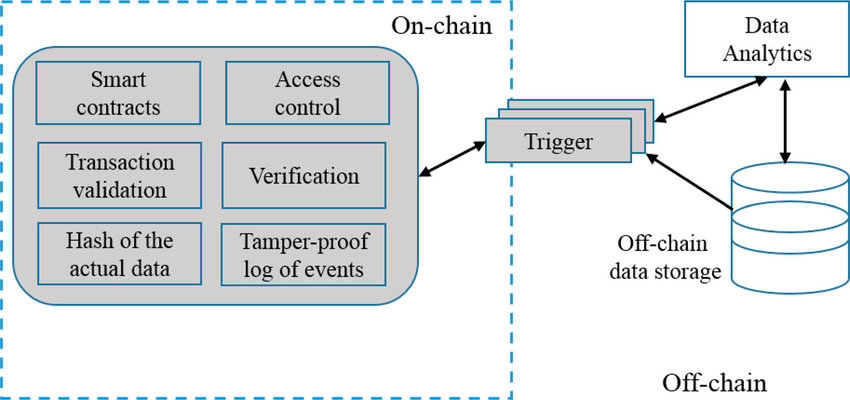
- AI inference runs off-chain (cloud CPUs/GPUs)
- Outputs are hashed
- Hashes and metadata are stored on-chain
- Smart contracts verify integrity
This keeps heavy compute off-chain while preserving an auditable trail.
Minimal Code Example
Hashing the output creates a commitment that can be verified later without revealing the raw data.
AI Inference (Cloud)
| |
Smart Contract (Verification)
| |
When This Pattern Makes Sense
- Financial risk scoring
- Fraud detection
- Model governance
- Compliance-driven AI
Closing Thoughts
AI decides.
Blockchain verifies.
Cloud scales.
Trying to collapse these roles is an architectural mistake. Keep the boundaries crisp and the system stays debuggable.